Tuesday, April 29, 2008
Sunday, April 13, 2008
Remember, On Television, We Can't Hear You Smile
David Letterman's "warm-up man," Eddie Brill, at left, performs the difficult task of warming up an audience truly in need of warming up... since The Ed Sullivan Theater is cooled to 50 degrees by two 120-ton Multistack Modular chillers by the time the audience is seated. Things warm up a bit when the stage lighting comes on, but the temperature at a Letterman taping never exceeds 60 degrees.Warm-ups seek to build a base of excitement and enthusiasm by convincing the audience that they are, in a very real sense, performers on the program. In the words of the great Hank Kingsley, "... the better you are, the better Larry is." This is exciting, isn't it?
Blogger Connie Wilson wrote an interesting piece about Letterman's pre-warm-up warm-up, delivered to her group as they waited to enter the theater:
“I’m going to say a punch line and I want you to laugh. The punch line is 'Donald Trump’s hair.'" We all bellowed like idiots on cue. He said to try again, only louder this time...
...The young man continued, “Now, if Dave makes a joke, I want you to think, 'Oh, boy, this is hilarious!' Laugh in the theater; think about it on the way home. ...We want you to really give back raw enthusiasm... Dave feeds on your energy..."
The better you are, the better Larry is.
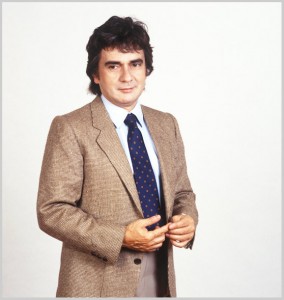
What made me start thinking about audience warm-ups was the viewing of a great sketch by Peter Cook and Dudley Moore.Most episodes of the team's TV series Not Only... But Also are missing, believed "wiped" by the BBC. This sketch somehow survived, but for some reason did not make it into The Best Of What's Left Of Not Only But Also. It's interesting because the casting is counterintuitive - usually Peter Cook is the strong, take-charge character, but here, Dudley's in charge... as both stage manager and warm-up man.
And, like all of their work, it's very, very funny.
Tuesday, April 8, 2008
Monday, March 31, 2008
House of Elliotts
Monday at 6 pm, I’ll be at The Paley Center for Media (the renamed Museum of Television and Radio) in NYC for a seminar/tribute to Bob and Ray (and Chris) hosted by Keith Olbermann and featuring a distinguished panel of Elliotts (Bob and Chris, whose novel The Shroud of the Thwacker is highly recommended).
In a recent NPR telephone interview, Bob’s voice sounds hardly different from the one we all grew up with. Mark Evanier provides a link to a recent article on the radio team. I had the extremely good fortune to work with Bob and Ray on an industrial video taped at the old
reception room was an open archway, beyond which was a wall jutting out perpendicularly which neatly bisected what had once been a single office. On the right side of the wall sat Bob, on the left side sat Ray, who could not see each other but could easily hear each other when speaking in a normal tone of voice. As the visitor, you saw both Bob and Ray; both Bob and Ray only saw you.
Butter 'em on the far side and write if you get work.
Labels: Bob and Ray
Friday, March 28, 2008
He's In The Cast Of Supporting Players And So Can You
This sketch is one of the funniest I've ever seen. (Wait for it; the last few seconds of the preceding sketch will hit your screen first)
Labels: Dana Carvey
Tuesday, March 18, 2008
The Art Of Banksy, With A Nod to Flora
I met a very interesting chap up at the Floratorium* by the name of Chris Wildman, who suggested that my online life would not be complete without a visit to the site of an English artist named Banksy.Turns out he was right. Very clever; very conceptual. Some of Banksy's art is pushing at the boundaries of good taste, but then, that's what art is supposed to do, right? Here's a link to a page on the site suitable for viewing by the whole family: Outdoor Work.
Disney fans may know Banksy from some 'outdoor work' he once did at Disneyland, placing an inflatable figure representing a Guantanamo detainee as an little extra added attraction for the riders of the Big Thunder Railroad attraction. That little prank is documented on Banksy's site in a three-minute video on his films page. His works have also been on display at New York's famed Metropolitan Museum of Art - don't miss the hilarious video, also on the films page, that tells the story.
If you decide to snoop around elsewhere on the site, be forewarned that some images might not be appropriate for all ages and political persuasions.

The Flora family is making limited edition prints available of a few of Flora's finest works, and during my recent visit I was able to compare some of these new prints directly with the originals. The new prints are astonishing works of art in their own right, losing absolutely nothing in translation, thanks to the dedicated, painstaking work of Barb Economon, digital media specialist at The Walker Art Center in Minneapolis. Amazing and recommended.
Labels: Banksy, Barbara Economon, Disneyland, Jim Flora
Monday, March 17, 2008
You've Seen The Movie...
...Now read the book! You've got to love these paperbacks. This one is tough, though, since it's a translation from the French original."Look here!" said Gévigne. "I want you to keep an eye on my wife."
"The devil! ...Running off the rails, is she?"
"Not in the way you think."
"What's the matter, then?"
"It isn't easy to explain... she's queer. I'm worried about her."
"What are you afraid of, exactly?"
Gévigne hesitated. He looked at Flavières..."
All right, I'll try to remember that the Jimmy Stewart character has his accent mark pointed backward, and the Tom Helmore character has his pointing forward...

Wow, the movie's in black and white, but the novelization is in color!
It's 1962, and novelist (novelizationist?) Irving Schulman is coming off one of his biggest novelization successes ever, West Side Story, which went through over twenty printings. It shows you how far some people will go to avoid reading Romeo and Juliet.
Intriguingly, the original short story upon which the film is based is titled The Notorious Tenant. I'm guessing that the movie-going public was more intrigued by a notorious Kim Novak than a notorious Jack Lemmon.

Well, no, maybe it's just Hollywood tradition.
In Rupert Hughes' story, the patent leather kid is the girl who dances her way into men's hearts. When First National films the epic two-and-a-half hour silent movie, however, they make Richard Barthelmess the patent leather kid, which is not to say that as a result he dances his way into men's hearts, but rather that the film script swaps the names of the two lead characters. The name of Curly Boyle, the boxer/soldier of the story, is given to Molly O'Day's character in the film.
No wonder there's a note on the dust jacket stating: "Be sure to read the introduction BEFORE YOU BEGIN."

Wow, the movie's in color, but the novel is in black and white!
The on-screen chemistry between Hayley Mills and Eli Wallach is electrifying. Why were they never teamed again?

OK, OK, calm down, take a deep breath, and I'll explain.
No, George Pal never made a sequel to The Time Machine. He wanted to, and this is a novelization of his script. Read the novelization and you will know why the movie never got made. George (The Time Traveler) and Weena (The Eloi pin-up girl) are killed in the first four pages, during World War II, presumably to set the stage for an all-new, cheaper cast.
The cover of the Time Machine II is calculatedly confusing. They put a Malcolm McDowell look-alike in Pal's time machine, presumably because McDowell had appeared as a time-traveling H.G. Wells in the film Time After Time (which Pal had nothing to do with) two years before this paperback original came out. Parenthetically, there have been lots of sequels written to the H.G. Wells novella. Stephen Baxter's The Time Ships is probably the best read of the lot, but the prize for best title goes to The Man Who Loved Morlocks, by David Lake.

Danny Kaye gets into trouble by extending credit to people who are clearly unacceptable credit risks, thus predicting the sub-prime mortgage crisis by a full 45 years.

Um, if you're going to put Frankie Avalon into a post-apocalyptic tale of survival... shouldn't it have been On The Beach?
Labels: Danny Kaye, Frankie Avalon, Hayley Mills, Kim Novak, Molly O'Day, Moonspinners, Patent Leather Kid, Richard Barthelmess, Vertigo
Monday, March 3, 2008
In New York City I Was Born In
New national motto coming soon: In God We Trust In.Labels: prepositions
Friday, February 29, 2008
Please Read Carefully Because Your Options Have Changed
It contains instructions on how to skip all the voice messages and get to a customer service representative at many, many companies.
The GH 500, in lawyer-like fashion, instructed me to say nothing and press no numbers when calling Verizon. I ignored seven or 8 recorded pleas for information and was then transferred over to customer service. Where I was put on hold, of course.
If only there were a fix for that.
Labels: internet services
Monday, February 25, 2008
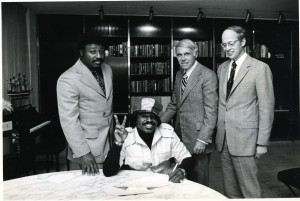
Soupy's On! WNEW-TV, March 1965
It's appropriate that Soupy's crew appears in these photos, because the crew was a big part of The Soupy Sales Show. We didn't see them at home, but we sure heard them. Soupy played to his crew. I somehow doubt that there was a meeting when crew laughter was considered, then adopted as official policy. The crew's near-constant laughter was not premeditated. These guys just couldn't help themselves.When Soupy himself laughed on-camera, it was nearly always commentary on the show. Soupy laughed, most often, at things we couldn't see... things he never explained.
- He craned to looked over the edge of the window when Pooky momentarily disappeared - and laughed at Frank Nastasi's difficulties in grabbing a prop, or trying to pull on the Hippy puppet with the hand that was already inside the Pookie Puppet.
- In close-up, standing near the camera, Soupy would look to one side or the other and start laughing, presumably at one of his crew members.
- When at the radio, Soupy would crack up when Frank Nastasi flubbed a line, which became even funnier when Nastasi broke the illusion that Soupy was tuning around the dial... by addressing him directly.

That's the stage manager, Eli, above, turning away from Soupy. Soupy talked about Eli so often that Eli became a recurring character on the show. Unlike the people who came to the door to annoy Soupy (all of them Frank Nastasi) we didn't even get to see Eli's hand, but he was more real than any of Soupy's visitors. Soupy did fat jokes and thin jokes and dumb jokes about his crew.
And here's the brilliance of it all: this made it funnier, and hipper, to the kids that were watching. Many children's shows had live, on-stage audiences... of children. And so, naturally, the host worked to the kid audience. Because Soupy worked to other adults while doing a children's show, Soupy's viewers felt that they were given access to the adult world. We weren't laughing at things other children were laughing at; we were laughing at things grown-ups were laughing at, and that made us feel pretty good.
We took it all for granted. Now we can see that it was a very specific, very special period of time. It was local. The people on our screen were live and they were from our town; they knew what the weather was like outside, at that moment.
We've lost local in the past 42 years. Local stores have been replaced by big box chain stores. Local restaurants yielded to franchises. Local hosts for kid's shows moved from 'endangered' to 'extinct' many years ago.
Thank goodness that talented people like Soupy... and Chuck McCann, Sandy Becker, Sonny Fox, Bob McAllister, and Fred Scott had careers that coincided with the narrow window of local TV supremacy. Those of us who were around for it... will never forget how good it was... and how good they were.
Labels: Soupy Sales
Saturday, February 23, 2008
You have attempted to connect to this page
while a web history tour is in progress.
Fusion50: When was it abdomened
TourGuide: early 21st century.
Fusion50: why
TourGuide: it should have been destroyed in the Google purge
TourGuide: The owner left and never came back
Fusion50: good move
Fusion50: but its not distroyed
TourGuide: When they shut down the blogosphere, they didn't bother to erase them all.
Fusion50: why borther
Fusion50: bother
Fusion50: i dont see what so special
Hstrygrl: Fusion50, all surviving blogs were declared protected historic sites
TourGuide: Right, content plays no role in preservation. The only thing that's 'special' is that it survived.
Hstrygrl: It's the retro templates, the drop shadows, that stupid header and things like counter styles etc that are interesting
TourGuide: This is one of three surviving Blogger sites that used TicTac (Blueberry).
Hstrygrl: It screams Dan Cederholm from 8 miles away
Fusion50: so its like an art thing they kept it
Hstrygrl: Tictac blue was less popular than Tictac green :-0

Fusion50: omg
artgeek: lol! Where'd you get that
Fusion50:so like thousands of people had blogs that looked exactly the same -what the point
artgeek: i think it's hysterical!!!!
TourGuide: The other tictac templates that survived are this one and this one.
artgeek: you're making my head spin
TourGuide: Any other questions? If not, meet me here and I'll answer any additional questions.
Monday, February 4, 2008
Sunday, February 3, 2008
Put It There, Pal - A Dog's Life In Hollywood
Identity issues - problematic for humans, but worse - far worse - for dogs.I mean, look at the confused expression on Pal's face in the still above, from Challenge To Lassie. The object of everyone's attention, and he's staring off into space, no doubt thinking, "Just who the hell am I, anyway?"
Pal, a male dog, is playing Lassie, a female dog. For most Hollywood stars, an entire career spent in drag would require plenty of couch time to sort things out. Pal, of course, was not allowed on the couch.It is generally agreed that Pal reluctantly agreed to appear as "Lassie" in the first Lassie film, Lassie Come Home, on the advice of his agent. From there, the story depends upon whose version you accept. Pal's agent claimed that Pal knew very well that he would have to be neutered for the role; Pal maintains that he was told only that "there were a few cosmetic issues that had to be addressed" before the film went into production.
Lassie Come Home was such a huge hit that Pal was forever typecast as the bitch who could always find her way home. Pal fired his agent both figuratively and literally, proving that he could, in fact, find his way to anyone's home when, long after filming had completed, the lack of an opposable thumb proved no barrier to the dog's determination to set his agent's house ablaze at 2 a.m. on September 29, 1943... barely two weeks before the film's New York Premiere. The negative publicity surrounding this incident would have irreparably damaged the movie's box office potential, and many historians believe that the agent's subsequent death (which took place two days after the arson incident, from which he escaped unharmed) was not the anguished suicide over Pal's defection that was presented in the press. (For more details on the fire, listen to Shawn Colvin's Sunny Came Home, originally titled Lassie Come Home and changed at MGM/Turner's request).
Intimates of Pal claim that the dog did not fully understand how far Eddie Mannix (left) would go after he promised the collie to "smooth things over and make this go away." Pal subsequently decided to drop out of sight for awhile by signing with The William Morris Agency. This is plausible, because collies lack a sense of humor, meaning Pal probably did not realize the William Morris line was a joke.In any case, Pal needn't have worried. No charges were ever brought by the agent's heirs.
Pal was next signed to star in a sequel, "Son of Lassie." When Pal got the script, however, he was horrified to see that he would not be playing Lassie in the sequel, but rather "Laddie, Son of Lassie."
"For this, I got neutered?" the canine was heard to mutter.
Again, Eddie Mannix (left) intervened, this time taking the dog aside for some straight talk. "There's a thousand dogs out there who can limp, walk on their bellies, paw doors, and whine," Mannix purportedly said. "Wake up and smell the kibble, Pal, you need MGM more than MGM needs you." Louis B. Mayer himself was even more blunt with Pal, who wanted to go out but was kept waiting for three agonizing hours outside Mayer's office. Finally ushered in to the great man's presence, Mayer outlined the canine's future at the studio in two words: "Sit. Stay." Daring to defy Mayer, Pal went. On an expensive carpet.Both physically and mentally castrated, the dog grudgingly did as he was told and prepared to reprise his role as "Lassie" in the third Lassie picture, The Courage of Lassie, even as his team of lawyers sought to break the contract. But Mayer and Mannix had one trick left up their communal sleeve: Pal was to be billed as "Lassie" in Courage of Lassie ... but in the film, "Lassie" (now Pal's legal name, but owned by MGM) would portray "Bill," yet another male dog.
It was the final straw. Pal crawled on his belly to Mayer's office, pathetically scratched at the door, and, when let in, rolled over on his back and whined, conclusively acknowledging Mayer as the alpha male at the studio.
Courage Of Lassie is today remembered primarily for the on-set incident that nearly killed Pal. A "post-Our Gang" Carl "Alfalfa" Switzer (who would die, ironically, in a shooting incident over a lost dog thirteen years later) portrays a young hunter in Courage of Lassie who accidentally shoots Bill (Lassie) (Pal).No one can explain why Alfalfa's gun was loaded with live ammunition; members of the crew claim to have checked and double-checked the "prop" rifle. There is a lingering suspicion that Switzer himself switched the blanks for live ammo, thanks to an unflattering interview suggesting this possibility given to the press by Roach star "Pete The Pup," actually retired at the time and living in the Motion Picture Country Kennel/Retirement facility in Toluca Lake.
Yet, again, there was a call to Mannix (left), who said he'd "see what he could do."A week later, a short press release from the Motion Picture Retirement Center announced that two stalwarts of the silent screen had been euthanized: Roach's beloved Pete The Pup and Charlie Bowers, a forgotten animator and slapstick comedian who had once dated Mannix's wife Toni.
Pal recovered (it was just a flesh wound) but the magic spark that had endeared him to audiences worldwide as Lassie, Laddie, Son of Lassie, Bill, and, in his best dramatic performance, Terry Malloy, was permanently extinguished. He continued to pile on the years, seven at a time. He married, adopted, divorced, and remarried. He never reconciled with his children, who later wrote the scathing expose entitled The REAL Lassie, as told to Bob Thomas, published, ironically, in The Saturday Evening Post, where the first Lassie story had been printed 100 years earlier.Pal died in 1958. In a moving eulogy delivered by close friend Charles Busch, he was remembered as "a dog unafraid to reveal his feminine side... with a masculine side that that was, and will be, sorely missed." Many in the audience were frankly skeptical that "Lassie" was truly gone for good, and were convinced that the famous dog would somehow find her way back to this life.
Sorry. His way back to this life.

Labels: Lassie, Mannix, True Crime
Saturday, February 2, 2008
Blockheads - The Laurel And Hardy Musical
A minute ago, I wouldn't have been able to tell you when I saw Blockheads at the Mermaid Theater, London. A quick search of the 'net, however, revealed that the play ran in 1984.I'm guessing that Blockheads was not terribly successful, since it seems to have run for a total of only 17 days. And I'm guessing it's not terribly well-known, since a Google search turns up nearly nothing about it. I was lucky to see it; lucky to be in the right place at the right time.
As I recall, the show was set 'backstage' during one of Laurel and Hardy's British tours, which places the action in the late 40's or early 50's.
You can get a sense of the plot from the song titles, the first of which is Have We Still Got It, sung by Laurel and Hardy. Then we flash back to the early days.
Stan sings a number called Playin' The Halls and then sings Star Quality with his father, who had been a vaudeville comic in his own right. A number titled Is This Where The Rainbow Ends? is sung by "Hardy and Minstrels." Laurel sings Goodbye Mae, presumably to his vaudeville partner and common-law wife Mae Dahlberg at the moment Stan decides to break up the act and try his hand at movies.
Any full-fledged L&H fan will smile at the cast members who sing a song called Timing - Hardy, Finlayson, and Hall. And perhaps some Laurel and Hardy fan more fully-fledged than I can decipher the meaning of a number in Act II sung by "Laurel, Hardy, and Finlayson" that's titled G.A.
Staging costs were kept to a minimum: the roles of Stan's Father, The Chef, Joe Rock, Hal Roach, and The Phantom of the Opera were all played by Larry Dann. Simon Browne played James Finlayson, a cameraman, a Keystone Cop, and Mr. Lubin.
The two stars looked - and acted - in an authentic, believable and sympathetic manner.

Mark Hadfield played Stan Laurel. He later joined the Royal Shakespeare Company and has had a distinguished career in the years that followed Blockheads.Kenneth H. Waller played Oliver Hardy. Prior to Blockheads, he appeared in Onward Victoria, which opened at the Martin Beck Theater in New York City on December 14, 1980, and closed at the Martin Beck on December 14, 1980; thus making Blockheads the more successful of the two productions.
For years, I used to walk into record stores hoping to find an original cast album. I've finally given up on that dream. There was no album, and there are no record stores.
Anybody else remember Blockheads the musical? Anybody want to stage a revival at a Sons Of The Desert Convention?
Labels: hal roach, Laurel and Hardy, Oliver Hardy, Stan Laurel
Locked Out Of My Own Blog
At least I got things right when I named the blog.
Labels: Apologies
Wednesday, January 23, 2008
Suzanne Pleshette at Disneyland

She was one of those people who lit up the screen; one of those people you felt as if you knew; one of those people that could make a mediocre film worth watching simply because she was in it. She could be sexy and funny at the same time; her dramatic roles were effortlessly natural and believable.Sad to say, I wasn't shocked when I read that Suzanne Pleshette had died. Supermarket checkout lines put all those ratty scandal-and-sensation newspapers at eye-level, and sometimes it's pretty hard to avoid noticing a headline. The one I happened to catch a few weeks ago was "Suzanne Pleshette Planning Her Funeral." I hoped it wasn't true, but I've seen those kinds of "soon to die" headlines before, and unfortunately, they're often correct.
It's no secret that Walt Disney himself had a major crush on Pleshette. Suzanne flirted with Disney when she was on the lot, something Disney seemed to enjoy. I guess the empire would have crumbled if Disney ended his less-than-fulfilling marriage, but it's interesting to speculate about the ways in which history might have changed...
She made three pictures at Disney's: The Ugly Dachshund, which one might reasonably expect to be a major Disney dud, but is delightful and funny; Blackbeard's Ghost, which I've never seen; and The Adventures of Bullwhip Griffin, which is far from a great movie, but a wonderful showcase for Pleshette.
Suzanne Pleshette appeared in two films released in 1963.
- One, of course, was Hitchcock's The Birds, where her Annie Hayworth had ten times the life and appeal of Tippi Hedrin's Melanie Daniels.
- The other '63 film, Wall of Noise, is a hoot. Suzanne gets to play the (very) bad girl in a horse racing saga. ('Wall of noise,' for those who may not know, is the expression for the roar of the crowd as the horses make the turn into the home stretch. The 'wall of noise' sometimes spooks even experienced horses).
Wall of Noise is not out on DVD; I'm not even sure if it was ever out on VHS.It's one of those mid-sixties Warner Brothers black and white programmers where they'd grab a few of their TV stars (in this case, Suzanne, Ty Hardin, and Dorothy Provine) and make a quick picture and a quick buck. If you see Wall Of Sound pop up on TCM, set the Tivo. I have an old 16mm print of the film, and it's a huge hit with friends whenever I run it.
But Suzanne Pleshette's major - and often overlooked - claim to Disney fame is that she appeared in the first feature film ever to be shot in Disneyland: 40 Pounds of Trouble. Who would have thought that Disney would allow Universal to use Disneyland as a background for a chase scene? But he did, and the footage of Disneyland seen in 40 Pounds is like a time capsule from the park circa 1961-2, featuring many scenes of many now-extinct attractions... as well as fabulous footage of nearly the entire park. It's terrific.
Suzanne looks lovely, as always. Walt Disney wasn't the only guy who had a crush on her. We miss you already, Suzanne.
Part 2
- Did they really think that they could get away with re-arranging Disneyland geography? Did they think no one would notice that they have the monorail drop Tony Curtis, Suzanne Pleshette, and Claire Wilcox off at the Main Street U.S.A. train station?
- Did they ever sell masks of JFK, Castro and Krushchev at somewhere near Hook's Pirate Ship in Fantasyland?
Labels: Disneyland, Suzanne Pleshette, Walt Disney
Saturday, January 19, 2008
A Letter Transposition Just Waiting To Happen

Article title from Discover magazine. Wait... it's already happened.
Labels: Unfortunate transpositions
Friday, January 18, 2008
Tuesday, January 15, 2008
Celery Stalk Queen With Crown Wanted
Over at YouTube, under the quickly-thought-up sobriquet SandySoup, I've posted quite a few videos (some of them with Sandy Becker and others with Soupy Sales). Some have appeared here on ILT, others have not.This email arrived via YouTube today:
Before 1964, my twin brother and I clearly remember seeing this weird sci-fi puppet show (no, not "Thunderbirds" Or "Fireball XL 5." It was supposed to take place on Venus and its queen was this howingingly funny "queen" who looked like a stalk of celery with a crown on. Does that spark any memories for you? Also, can you find any of the old "Space Angels? Dig those real human mouths superimposed over barely moving animated figures!
The celery-stalk Venusian Queen... funny, you'd think you'd remember something like that. Sounds familiar, but offhand, I can't think of what it might be. Anybody around here know?
In Jerry Beck's "Cartoon Dump" show in NYC (see below), one cartoon selected for presentation was Captain Fathom, one of those Cambria Productions "live lips supered onto drawings" shows. Jerry also mentioned something I never knew - that ALL the lips - ALL of them - belonged to Margaret Kerry, who was married to the producer. She lip-synched recordings of the male voices and did a few of her own. And she was, and many of you know, the model for Disney's Tinkerbell.
Here's some trivia: Conan O'Brien's writing staff calls their comedy bits where superimposed lips are placed over pictures of politicians their "Clutch Cargo" segments, a reference to another of the Cambria "lips-only" animation titles.Labels: Cartoon Dump, clutch cargo, marionettes
Sunday, January 13, 2008
The Curse of the Broken Lever
Think of [your blog's] readers as laboratory animals in an experimental cage that's equipped with a bunch of levers. If the lever you control dispenses a tasty morsel each time it'spushed, the animals will keep coming back for more. If you forget to provide a treat for the animals' effort, the animals will stop pressing your lever and look for a more reliable source of nutrition. That's why it's good to post at least one blog entry a day, because people will get used to the idea that your blog will deliver a treat each time they visit.
- Tip Number 4 for running a popular blog, from Rule The Web, Mark Frauenfelder's guide on 'How to do anything and everything on the internet - better, faster, and easier.'
Long ago, I recommended Mark's book to anyone and everyone who uses the internet, giving it the highest possible praise by suggesting its title could have been, and should have been, The Junior Woodchuck's Guide to the Internet. It was nice to read that this pleased Mark.
Mark's very first blogging tip says that:
...I'm surprised at the number of people who post things just because they think they will attract more readers to their site... if you aren't passionate about the things you're writing about, readers will quickly become bored and never return.
And there, fellow lab animals, lies the problem. I think Mark Frauenfelder is exactly correct, and up until quite recently, I've tried to provide a morsel per day.
Future morsels will be just as tasty, but new ones will probably appear on a less-than-daily schedule. I expect that the ones that do find their way here will be all the more tasty, given the added prep time.
Please come and press the lever every so often, even though I admit defeat in balancing Mark's first and fourth tips on a daily basis.
Spencer Tracy characterized Katherine Hepburn once by saying "There ain't much meat on her, but what's there is cherce [sic]." Less posts here, but what goes up will be cherce, and that's a promise.
Tuesday, January 8, 2008
Cartoon Dump!

Cartoon Dump is presented exclusively on the West Coast. Usually, it's the West Coast of the country, but last night, it was the West Coast of Manhattan, and it further infuriated the New Yorkers who read about Dump (and other upcoming animation-related events) on Cartoon Brew by confirming our worst fears: we've been missing out on great entertainment because we insist on living in this backwater town.
Oh, sure, you can go over to the Cartoon Dump section of YouTube and see snippets of the show, and the hysterically awful semi-animated cartoons Jerry Beck has selected to showcase. But this is live theater we're talking about here, with very talented, deeply funny performers. I'm telling you, I've seen Young Frankenstein on Broadway, and it's strictly for tourists and chumps. Rent the DVD. Cartoon Dump packs twice the laughs into half the time.
Erica Doering is a relentlessly chipper comedic powerhouse; her cartoony voice and condescending showmanship suggest Hillary Clinton on helium. Frank Conniff gives a great deadpan performance (and had some great ad libs) as Moodsy, the Clinically Depressed Owl. This guy could just look at the audience and get a laugh. Kathleen Roll reminds me of Paula Prentiss (and that's high praise); her Buff Badger not only provides angry historical context for the cartoons, but also fully explains the furry phenomenon for those who don't quite get it. And of course, there's animation legend Jerry Beck. (There is not a single animation legend anywhere in the 2 1/2 hours of Young Frankenstein, by the way).
I'm just hoping there was a Saturday Night Live scout somewhere among us who decides to sign the whole team up and keep Cartoon Dump in New York, where they belong.
Labels: animation, Cartoon Brew, Cartoon Dump
Name These Disney Artists/ FX Artists!

"Disney artists earn while they learn the profession of animation. To them are entrusted the inconsequential bits of action. They are directly supervised by one of the regular animators."
"Comparable to a set designer in a live-action studio is this man - a layout artist in Disney terminology. He is one of the artists who design the watercolor backgrounds used in the animated productions."
"A corner of the sound effect department. Thousands of sounds, from frog croaks to train wheels, are filed away in little drawers."
"The sound effects boys are on the verge of giving the pictured crates a tumble. The result will probably be a sound effect of Donald Duck taking a spill."
The Dionnes, Part 3
Sorry for the delay; I need to get some decent video editing software. (The first two video clips are silent, the third has sound.)Dr. Dafoe quarantined the Dionne Quintuplets "to keep the germs away." That meant keeping people away, too - like the Quints' parents and the rest of their family. The first clip shows the result: Jean Hersholt, who played a version of Dr. Dafoe in the three 20th Century Fox features, presents a puppy to the sisters. They've never seen a puppy before (dogs have germs, except when Hollywood needs a puppy scene), so the sisters are frightened and back away. It was supposed to be a cute scene. You'll see that they stopped the camera, probably had a talk with the girls, then started again. It clearly deomnstrates their isolated existence - yet it was used in the feature as you see it here. (36s)
The next clip contains scenes of Quintland, the world's first theme park. It's estimated that three million people made the trip to see the Quints in person. Often, over two miles of stop-and-go traffic "clued everyone in" that they were getting close.
The Dafoe Hospital had an outdoor playground. Surrounding it on three sides was an enclosed, horseshoe-shaped viewing area. Supposedly, the darkness insid